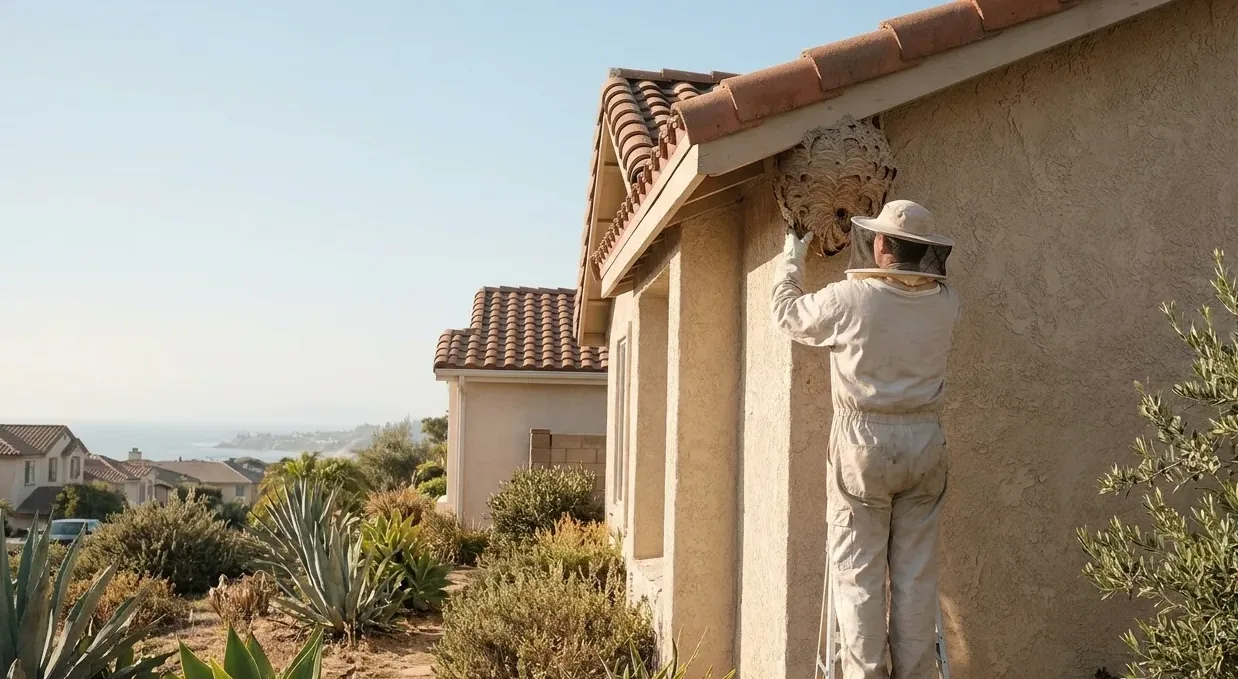
Rafter gaps, soffit joins and corroded vents along the eave line, closed in metal from a ladder on every elevation.





Rodents do not keep office hours. Someone answers the Pasadena line at night and at the weekend, so you can book the visit when you find the problem rather than the next working morning.
Your technician confirms a window with you directly and works around school runs, shift patterns and trading hours instead of handing you a vague all-day slot.
Call before midday and same-day service across Pasadena is usually available. The person who inspects your property is the person who treats it and comes back for the follow-up.
The overhanging eave is the most characteristic thing about Pasadena's older housing and the most reliable way into it. On a Craftsman bungalow the roof extends well past the wall, the rafter tails are exposed, and the underside is either open or boxed in with a soffit added decades later. Every one of those arrangements has a way in.
On an open eave the rafters pass over the top of the wall with a gap between each pair. Those gaps are supposed to be blocked, and on a great many houses either the blocking was never fitted or it has shrunk, split or been removed during a re-roof. From the ground you cannot see them at all.
Where a soffit was boxed in later — and on most of this stock it was — the join between the soffit board and the stucco or siding is the weak point. Movement over decades opens it, and it runs the full length of the elevation.
Necessary for ventilation, and on older houses fitted with light screen that has had eighty years to corrode. A vent with a hole in it is simply a door with a frame around it.
Porches, dormers and rear additions all create a point where one roof plane meets another. Those junctions are where flashing was fitted, and where flashing has lifted there is a gap directly into the roof void.
Tell us what you have seen and where. We will book an inspection, put the findings in writing and only then talk about treatment.
Call (323) 301-7551Because on this housing the animals are arriving from above. Mature street trees and garden trees put branches within reach of the roof across most of the older districts, so the climb is already solved before a rat gets anywhere near your walls. What decides whether it gets inside is the eave line.
A house that has been treated repeatedly and keeps having the same problem has almost always had the eave line left alone, because reaching it properly means a ladder on every elevation and a slow look at a detail nobody photographs.
Sealing is the half of the job still working after everyone has gone home, and it is the half Rodent Control Pasadena will not shorten to meet a price.
Rafter gaps are blocked in metal or a metal-faced closure rather than timber, which is chewed. Soffit joins are closed with flashing bedded in sealant. Vents are re-screened in stainless where the exposure warrants it, rather than patched. Where a rafter tail or a fascia board has rotted, we say so and recommend it is repaired before anything is fitted over it.
Every opening is photographed before it is closed and again afterwards. It is the only way you will ever see work done two and a half metres up under an overhang.
One call books the inspection. We will tell you what we find, what it will take to fix and what you can do yourself — before you commit to anything.
Call (323) 301-7551