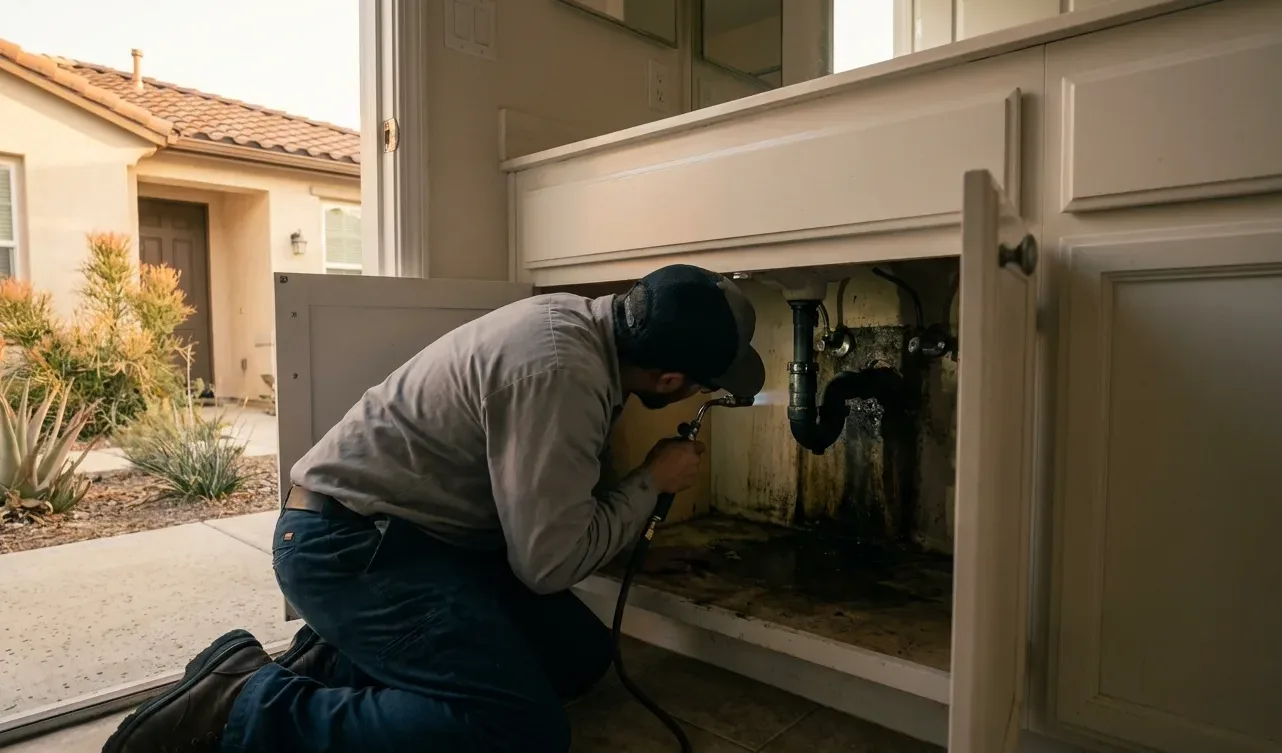
Entered and walked rather than inspected from the hatch. Vent screens replaced, not patched.





Rodents do not keep office hours. Someone answers the Pasadena line at night and at the weekend, so you can book the visit when you find the problem rather than the next working morning.
Your technician confirms a window with you directly and works around school runs, shift patterns and trading hours instead of handing you a vague all-day slot.
Call before midday and same-day service across Pasadena is usually available. The person who inspects your property is the person who treats it and comes back for the follow-up.
Most of Pasadena's older housing sits above the ground rather than on it. There is a subfloor void under the boards — anything from a crawl height of a foot to something you can walk stooped through — and it is ventilated by screens set into the foundation wall. That void is the part of the house nobody looks at, and it is where a great many of our jobs actually are.
It is dry, dark and completely undisturbed. It is thermally buffered by the house above. It is connected upward into wall cavities and, on many houses, into the roof void via the same chases the plumbing and wiring run through. And it is entered through a screen that has been in place for eighty years.
The practical result is that an animal can be living under your floor, travelling up inside a wall, and appearing in the roof space, without ever crossing an open room. Most owners are genuinely surprised by that, and it explains why noise sometimes seems to move around the house.
Droppings along the tops of joists, which is where they run. Greasy rub marks where fur has repeatedly brushed the same timber. Nesting in insulation where the underfloor has any. Occasionally chewed cable, which matters more than the rest of it and gets photographed and referred to an electrician.
We also find the entry point, which on a raised foundation is almost always at the vent line. A screen that looks intact from two metres away frequently has a corroded hole at one corner, and one hole is all it takes.
Very few owners have ever been under their own floor, which is exactly why Rodent Control Pasadena goes in there first on a raised-foundation property.
Standing water or damp from a plumbing leak, which brings in animals looking for water rather than food. Debris left under the house by previous trades — offcuts, packaging, old insulation — which is both harbourage and nesting material. Access hatches left off or never refitted. Grade built up against the foundation wall over decades of landscaping, which brings soil level up toward the vents and sometimes above them.
Tell us what you have seen and where. We will book an inspection, put the findings in writing and only then talk about treatment.
Call (323) 301-7551The void is entered wherever it is safe and physically possible, because inspecting a subfloor from the hatch with a torch tells you almost nothing. Traps go on the joist runs. Vents are replaced rather than patched, in stainless where the exposure warrants it, because a repaired screen on a hundred-year-old foundation is a repair you will be making again.
Once the catch rate has gone to nothing, the vent line and every penetration through the foundation wall get closed. Then, where there is contamination worth dealing with, the void is cleared and treated. Insulation that has been soiled comes out rather than being turned over.
Where the subfloor has a damp problem, we will say so and tell you it needs addressing by somebody else first. Sealing a wet void against rodents leaves you with a wet void. It is not our trade and we would rather point at it than quietly work around it.
One call books the inspection. We will tell you what we find, what it will take to fix and what you can do yourself — before you commit to anything.
Call (323) 301-7551