Craftsman and Victorian stock on raised foundations, much of it original. Under the floor is where a South Pasadena survey spends most of its time.





Rodents do not keep office hours. Someone answers the Pasadena line at night and at the weekend, so you can book the visit when you find the problem rather than the next working morning.
Your technician confirms a window with you directly and works around school runs, shift patterns and trading hours instead of handing you a vague all-day slot.
Call before midday and same-day service across Pasadena is usually available. The person who inspects your property is the person who treats it and comes back for the follow-up.
South Pasadena is one of the most consistently preserved early-twentieth-century housing stocks in the region — Craftsman, Victorian and Mediterranean revival, largely unaltered, on raised foundations under mature canopy.
Foundation vents that are the ones the house was built with. Open eaves with rafter gaps that were never blocked. Timber detail at ground level that has been in contact with damp soil for a hundred years. These are structural entries, not accidental ones.
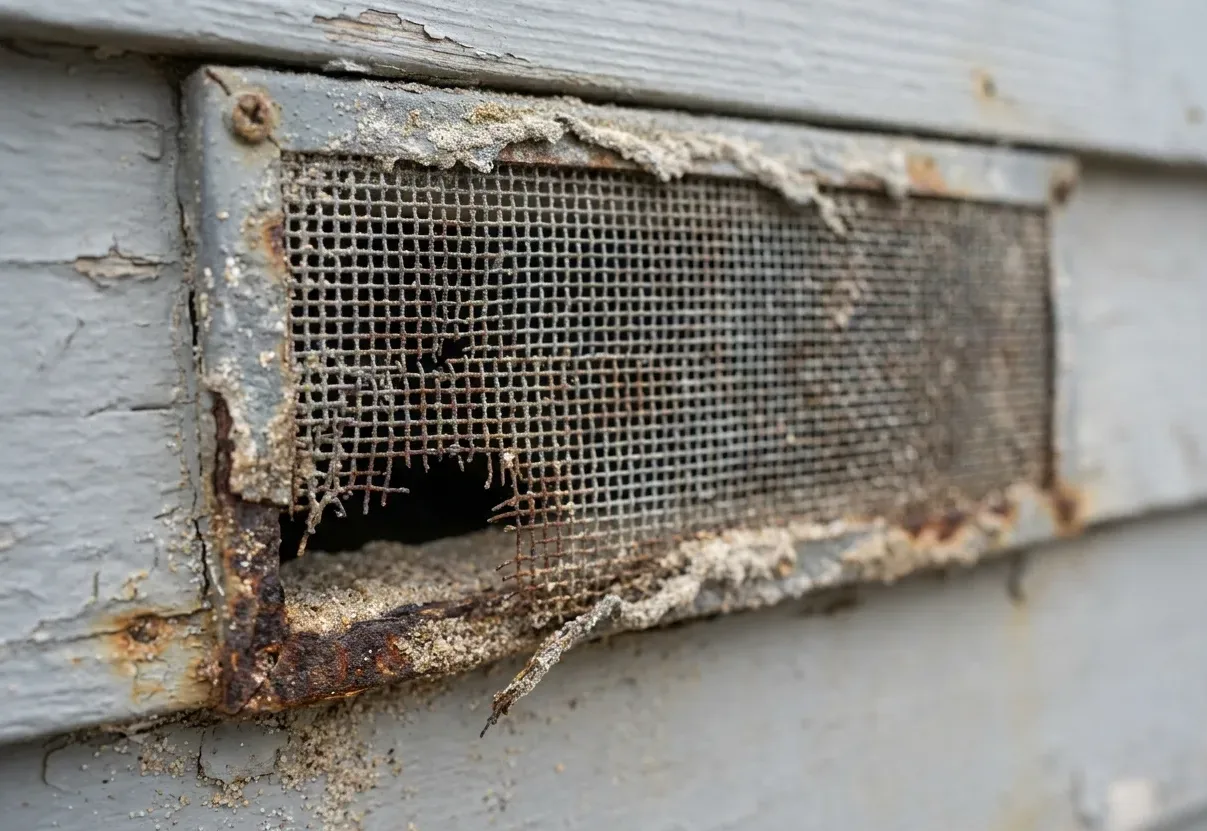
Most of a South Pasadena survey is spent under the floor, and Rodent Control Pasadena would rather book the extra hour than report on a crawl space it only looked into.
Screens can be replaced in a period-appropriate pattern; mesh can be fitted behind a detail rather than across it. On this housing we would rather take longer than fit something crude, and where a repair is a carpenter's job we say so rather than covering it over.
Rodent control here is a building trade more than a chemical one. An animal comes in at a particular opening, lives in a particular void, and runs a fixed line between the two. Settle those three and the problem is finished. Leave one and it comes back, usually within a season — and in South Pasadena, as everywhere in this city, the openings are decided by how the house was built rather than by how clean it is kept.
Roof rats are taken high, along rafters and in voids. House mice are taken within a few metres of whatever they are eating. Norway rats are taken low, at or below ground level. A building closed against one is frequently still open to another, so we settle which it is from droppings, rub marks and gnawing before a single trap goes anywhere.
Most older Pasadena houses have a subfloor void as well as a roof void, and on a great many of them the two are joined by the same chases the plumbing and wiring run through. That is why noise appears to move around a house, and it is why we inspect underneath as well as above. Working only the roof on this housing stock finds half the problem.
Closing a building that still has animals inside leaves them dying in a wall cavity or under a floor, out of reach. The order on every South Pasadena job is the same: identify, trap out, confirm the catch rate has gone to nothing, then close the building.
Every opening that let an animal in is sealed with galvanised or stainless mesh, hardware cloth or metal flashing. Expanding foam is chewed straight through and steel wool pulls out by the strand. On a period house we will also say plainly where the right answer is a carpenter rather than a mesh patch — a rotted rafter tail is not something to cover over and call finished.
Most of what keeps pressure high around a South Pasadena property is within a few metres of the walls and is fixable: branches touching the roof, ivy climbing the elevations, fruit left where it falls, woodpiles against the house, unsecured bins, open compost, bird feeders, and irrigation that runs on through a dry autumn. We go through all of it, including the parts that are a neighbour's to put right rather than yours.
Tell us what you have seen and where. We will book an inspection, put the findings in writing and only then talk about treatment.
Call (323) 301-7551It is the most common way in on this housing. A century of corrosion leaves a screen that looks sound from the path and has a hole at one corner, and one hole is enough.
Wherever access allows, yes. On a raised foundation the subfloor is where the evidence is, and inspecting it from the hatch with a torch tells you almost nothing.
That is the thing we are working around rather than through. Screens are replaced in a period-appropriate pattern and mesh goes behind detail rather than across it.
No. Mesh over rotten timber is not a repair, and we will say plainly that it is a carpenter's job before anything is fitted.
One call books the inspection. We will tell you what we find, what it will take to fix and what you can do yourself — before you commit to anything.
Call (323) 301-7551