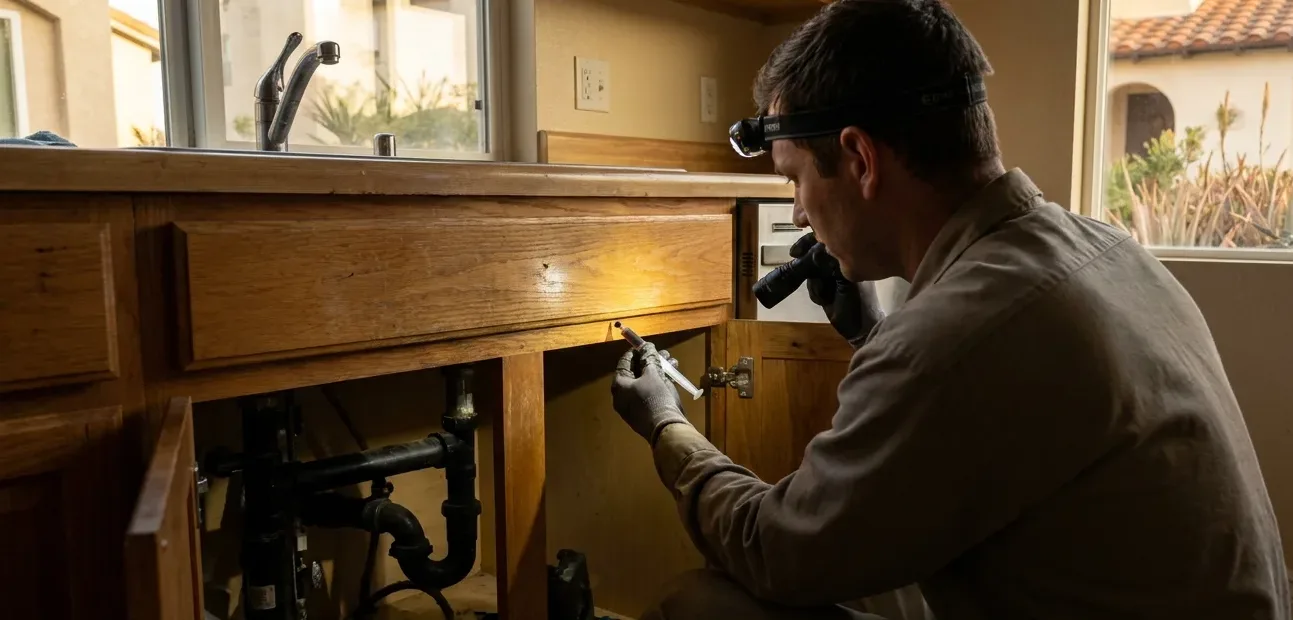
Soiled insulation removed rather than turned over, the void treated, and the scope agreed from photographs first.





Rodents do not keep office hours. Someone answers the Pasadena line at night and at the weekend, so you can book the visit when you find the problem rather than the next working morning.
Your technician confirms a window with you directly and works around school runs, shift patterns and trading hours instead of handing you a vague all-day slot.
Call before midday and same-day service across Pasadena is usually available. The person who inspects your property is the person who treats it and comes back for the follow-up.
When the animals are gone, what they built is still there. On the older Pasadena housing that usually means nesting in a subfloor void, in a deep eave, or in whatever insulation the roof space has — shredded paper, fabric, dry leaf litter carried in, chewed cable sheathing and stripped insulation, bound up with droppings and urine.
Scent marking left in soiled insulation is what advertises the address to the next animal, so Rodent Control Pasadena treats clearance as part of the job rather than an upsell after it.
Rodent runs are scent-marked, and that marking outlasts the animals by a long way. To the next rat coming along a branch onto your roof it reads as an endorsement — this address worked for someone. Properties that were trapped and sealed but never cleared have a habit of re-presenting, and this is much of the reason why.
Material that has been compressed along a runway and soaked does not recover. You are heating and cooling the house around insulation that is no longer insulating, and it holds the smell indefinitely.
Accumulated droppings and nesting carry organisms that matter. This is the part of the job that most warrants doing properly rather than being swept out with a broom on a Saturday.
The void is cleared of nesting, droppings and debris. Soiled insulation is removed rather than turned over — turning it simply buries the contamination in the middle of the batt. The area is then treated and deodorised, which is what actually removes the marking rather than covering it, and insulation is made good to the depth that was there.
On a bungalow the subfloor frequently needs this as much as the roof, and it is the space most often skipped because getting into it is uncomfortable.
Tell us what you have seen and where. We will book an inspection, put the findings in writing and only then talk about treatment.
Call (323) 301-7551Clearance comes after trapping and after sealing, never before. Clearing a void that still has animals living in it achieves nothing, and sealing a building with an active population inside leaves animals dying in the structure — which produces a far worse contamination problem than the one you started with.
So: identify, trap out, confirm the catch has gone to nil, seal, then clear. Any company offering to begin with the clean-up is starting with the visible part.
Clearance is quoted up front against what the survey photographs actually show — how much insulation is affected, how far the runways extend, whether wiring is involved. Not as a figure that materialises once you are committed. Where the contamination is light and confined we will say so, and where it is most of a void we will show you why before anything comes out.
Chewed wiring is photographed and referred to an electrician. It is not our trade and we will not pretend it is.
One call books the inspection. We will tell you what we find, what it will take to fix and what you can do yourself — before you commit to anything.
Call (323) 301-7551